Concrete Driveway Replacement in Denver: When Repair Is No Longer Enough

A concrete driveway can make a major difference in the appearance, safety, and functionality of a property. But when a driveway begins developing large cracks, sinking sections, surface deterioration, or drainage problems, homeowners often face the same question:
Should the concrete be repaired, or is it time for a complete driveway replacement?
In Denver and throughout the Front Range, concrete has to withstand freezing temperatures, repeated freeze-thaw cycles, snow, moisture, intense sunlight, vehicle traffic, and changing soil conditions. Those factors can turn a small concrete problem into a much larger one if the underlying cause is not addressed.
JL Enterprise provides concrete installation, replacement, repair, and flatwork throughout the Denver metro area. Our goal is simple: identify what is actually causing the problem and recommend the right solution rather than replacing concrete that could still be properly repaired.
Signs Your Denver Concrete Driveway May Need Replacement
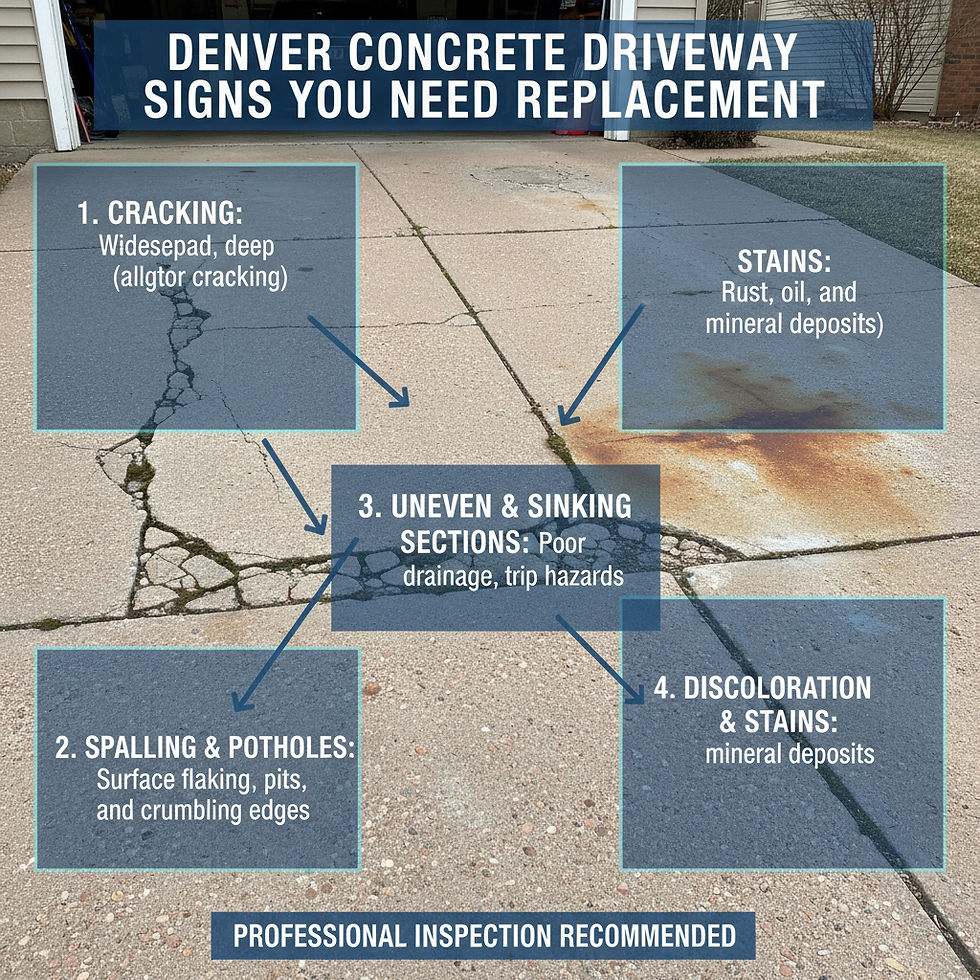
Not every crack means you need a new driveway. Small surface imperfections can sometimes be repaired. However, certain types of damage indicate that the concrete or the material underneath it has deteriorated too far for a simple repair.
Large or Widespread Cracking
A few isolated hairline cracks are not necessarily a reason to replace a driveway.
The situation is different when cracks are:
Wide or deep
Repeated across large sections
Spreading in multiple directions
Causing pieces of concrete to separate
Returning after previous repairs
When cracking is widespread, patching individual areas may only provide a temporary improvement.
Sunken or Uneven Sections
Sections of a driveway that have settled can create both appearance and safety problems.
Settlement can also affect drainage. Instead of moving water away from the home, an uneven driveway can create low areas where water collects.
If the underlying soil or base has moved significantly, simply repairing the surface does not necessarily solve the problem. The underlying conditions need to be evaluated.
Concrete That Is Spalling or Deteriorating
Spalling occurs when the surface of concrete begins breaking apart or flaking.
Colorado's weather can be particularly hard on exterior concrete. Moisture that enters the concrete can freeze and expand, contributing to surface deterioration over repeated cycles.
If deterioration is limited to the surface, repair or resurfacing may be possible. If the deterioration is extensive or the slab has lost structural integrity, replacement may be the better long-term option.
Repeated Repairs Are No Longer Working
One of the clearest signs that replacement should be considered is a driveway that continually needs repairs.
If cracks or damaged sections keep returning after patching, the problem may be deeper than the surface.
A replacement gives the contractor an opportunity to address the entire installation, including the existing concrete, subgrade, drainage, grading, reinforcement, joints, and new concrete.

Why Denver's Climate Matters
A concrete driveway in Denver is exposed to conditions that can accelerate deterioration when the installation is not properly designed and prepared.
Freeze-thaw cycling is one important consideration.
Water can enter small openings in concrete. When temperatures drop, that moisture freezes and expands. Repeated cycles can contribute to cracking and surface deterioration.
Denver-area properties can also have soil and drainage conditions that affect concrete performance. That means a durable driveway is not simply about putting new concrete on top of an existing surface.
The preparation underneath the concrete matters.
What Happens During a Professional Driveway Replacement?
A quality driveway replacement should involve much more than demolishing the old slab and installing new concrete.
1. Site Evaluation
The first step is evaluating the existing driveway and surrounding property.
This includes looking at:
Existing cracks
Settlement
Drainage
Slope
Access
Existing concrete thickness where relevant
Soil and subgrade conditions
Connection points to sidewalks, garages, streets, and other surfaces
The goal is to determine why the existing driveway failed.
2. Removal of Existing Concrete
If replacement is necessary, the damaged concrete is removed and hauled away.
Proper demolition also gives the contractor an opportunity to inspect what was underneath the original driveway.
3. Subgrade and Base Preparation
This is one of the most important parts of the project.
A driveway can look excellent when it is first completed, but poor preparation underneath the slab can contribute to settlement and other problems later.
The base and subgrade should be evaluated, graded, and properly compacted for the conditions of the property.
4. Grading and Drainage
Water management should be considered before the new concrete is installed.
The driveway needs to work with the surrounding grades so water moves where it is supposed to go rather than collecting against the home or in low areas.
Drainage problems should be addressed as part of the overall project whenever possible.
5. Reinforcement and Forming
Forms establish the dimensions, edges, elevations, and slopes of the new driveway.
Reinforcement can also be incorporated based on the project's design and expected loads.
Control joints are another important part of the installation. Concrete naturally moves and can crack, so properly planned joints help control where cracking occurs.
6. Concrete Installation and Finishing
Once preparation is complete, the concrete is installed and finished according to the project's specifications.
The finish can be selected based on the property's appearance, use, and desired maintenance requirements.
For a standard residential driveway, a broom finish is one common option because it provides texture while maintaining a clean appearance.
7. Curing and Final Inspection
Concrete does not reach its full performance immediately after installation.
Proper curing and protection are important during the early stages of the project. The contractor should also explain when the driveway can safely handle normal foot and vehicle traffic.
A final walkthrough helps ensure the completed work meets the agreed-upon scope.
Repair vs. Replacement: Which One Is Right?
There is no single answer for every driveway.
Repair may make sense when:
Damage is relatively localized
The slab remains structurally sound
Settlement is limited
Cracking is minor
The underlying base is still suitable
The homeowner wants to extend the life of an otherwise serviceable driveway
Replacement may make more sense when:
Cracking is extensive
Multiple sections have settled
Large portions are deteriorating
Previous repairs continue to fail
Drainage or grading problems are significant
The existing base is inadequate
The driveway has reached the end of its useful life
A professional evaluation can help determine which approach makes sense before unnecessary demolition takes place.
How to Choose a Concrete Contractor in Denver
Choosing the lowest bid is not always the best way to evaluate a concrete project.
Instead, homeowners should ask what is actually included in the scope of work.
Important questions include:
Will the existing concrete be completely removed?
How will the subgrade be prepared?
Will the base be evaluated?
How will drainage and slope be handled?
What reinforcement is being used?
Where will control joints be placed?
What concrete specifications are being used?
How will the finished surface be protected and cured?
Is demolition and haul-away included?
Who will actually perform the work?
A detailed estimate should make it clear what you are receiving rather than simply giving you a single number.
Concrete Driveway Replacement Throughout the Denver Metro Area
JL Enterprise provides concrete services for homeowners, property owners, HOAs, and commercial properties throughout the Denver metro area.
We work with customers in communities including:
Denver, Thornton, Arvada, Westminster, Longmont, Lakewood, Golden, Boulder, Centennial, Castle Rock, and surrounding Colorado communities.
Our concrete services include driveway replacement, concrete repairs, patios, sidewalks, slabs, ADA ramps, curbs and gutters, retaining walls, and other concrete improvements.
We focus on clear communication, proper preparation, quality workmanship, and completing the scope of work correctly.
Is Your Driveway Ready for Replacement?
If your driveway is cracked, uneven, deteriorating, or repeatedly needing repairs, the right answer may not always be another patch.
A professional evaluation can determine whether repair, resurfacing, or complete replacement makes the most sense for your property.
JL Enterprise provides concrete driveway replacement and concrete services throughout the Denver metro area. Contact us to schedule an estimate and discuss the condition of your driveway.
JL Enterprise LLC
Chasing Perfection in Asphalt & Concrete. Denver Metro Area Concrete & Asphalt Specialists


Comments