Commercial Concrete Repair in Denver: What Property Managers Should Fix Now vs. Plan for Later
For a property manager, concrete problems rarely arrive one at a time.
A cracked sidewalk may be next to a deteriorating curb. A damaged parking-lot panel may be creating drainage problems. A balcony may need resurfacing while residents are still using the building. A small trip hazard may be easy to ignore until it becomes part of a much larger maintenance project.
The difficult part isn't always finding a contractor.

It's knowing which concrete problems need attention now, which can be planned for later, and which require more investigation before anyone starts breaking concrete.
JL Enterprise provides commercial concrete and asphalt services throughout the Denver metro area, working with property managers, property owners, real estate professionals, businesses, and other commercial clients.
This guide explains how to evaluate common concrete problems and plan repairs more effectively.
Not Every Concrete Problem Requires Immediate Replacement
One of the biggest mistakes property owners can make is treating every damaged section of concrete the same way.
A hairline crack, a settled sidewalk panel, widespread surface deterioration, and a structurally failed slab are completely different problems.
The appropriate solution could be:
Localized repair
Joint or crack repair
Surface restoration
Leveling
Partial panel replacement
Complete replacement
Drainage correction
A combination of several repairs
The right approach depends on what caused the damage and how far it has progressed.
That is why a good commercial concrete evaluation should look beyond the visible crack.
Concrete Problems Property Managers Should Prioritize
A useful way to manage concrete maintenance is to divide problems into three categories:
Address now
Plan for the next project window
Monitor
This doesn't replace a professional site evaluation, but it provides a practical framework for organizing maintenance.
1. Address Now: Severe Trip Hazards and Broken Concrete
Severely uneven or broken pedestrian surfaces deserve immediate attention.
These areas can include:
Sidewalks
Building entrances
Walkways
Parking-lot pedestrian routes
Stairs and landings
Accessible routes
Areas around dumpsters
High-traffic paths
The more frequently an area is used, the more important it becomes to address obvious hazards quickly.
A property manager should document the location, photograph the condition, and determine whether temporary controls are necessary while a permanent repair is scheduled.
Don't just repair the visible edge
If one concrete panel has shifted, look at the surrounding panels.
Settlement can extend beyond the section that initially catches your eye.
Replacing one piece of concrete without understanding why it moved can result in the same problem returning.
2. Address Now: Water Problems Around Concrete
Standing water deserves attention even when the concrete itself doesn't look severely damaged.
Water can contribute to deterioration and can also reveal a grading or drainage problem.
Look for:
Water collecting beside sidewalks
Puddling near entrances
Drainage toward buildings
Water collecting at low points
Damaged concrete around drains
Erosion around concrete edges
A new slab doesn't automatically solve a drainage problem.
If water is being directed toward the wrong location, the surrounding grade and drainage conditions should be considered as part of the project.
The question to ask
Where is the water supposed to go?
That simple question can prevent a property owner from paying for the same problem twice.
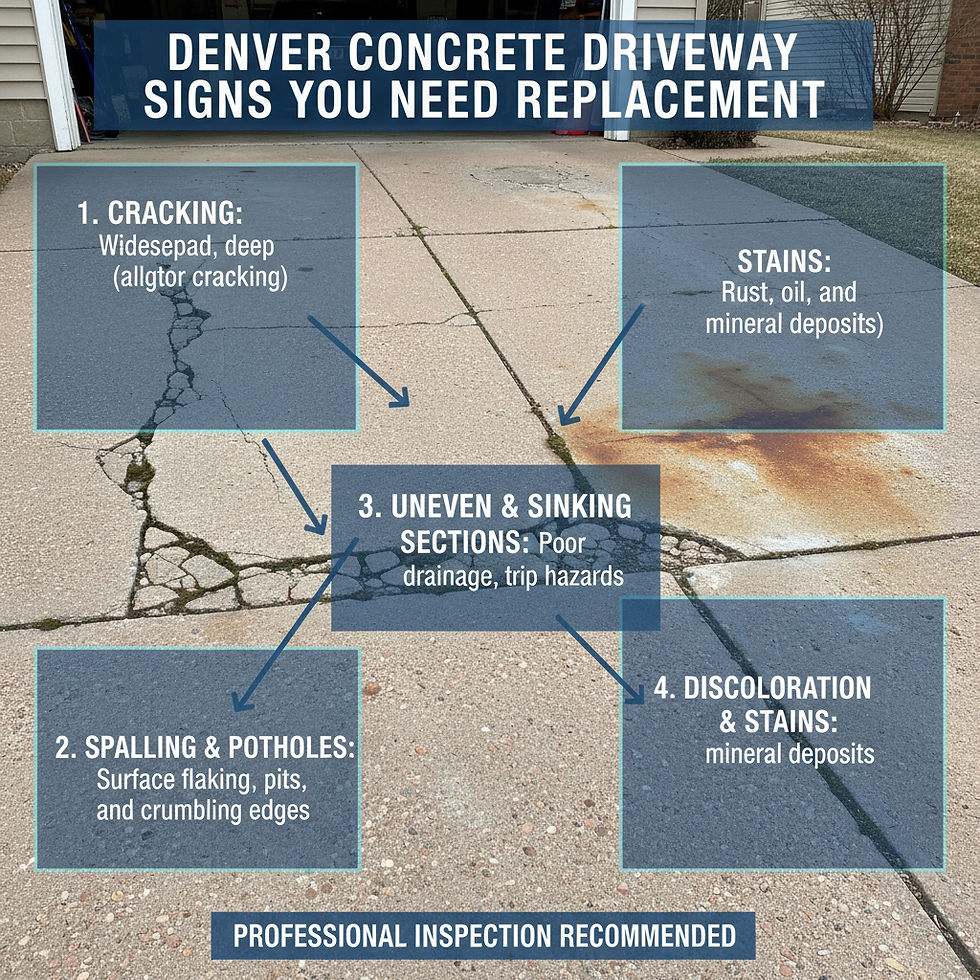
3. Plan Ahead: Widespread Cracking

A few small cracks don't necessarily mean an entire concrete area needs replacement.
But widespread cracking deserves a closer look.
Document:
How many panels are affected
Whether cracks are isolated or interconnected
Whether the cracks are widening
Whether sections are moving vertically
Whether previous repairs have failed
Whether water is entering the damaged areas
If multiple sections are deteriorating, it may make more sense to plan a larger repair rather than repeatedly dispatching maintenance crews for small patches.
For property managers, this can also make scheduling easier because multiple repairs can potentially be completed during one mobilization.
4. Plan Ahead: Spalling and Surface Deterioration
Spalling occurs when the surface of concrete begins breaking, flaking, or scaling.
Denver's outdoor concrete experiences significant seasonal exposure, including freezing temperatures, snow, moisture, and deicing materials.
Surface deterioration can range from relatively minor to extensive.
A contractor should determine whether the problem is primarily superficial or whether the concrete has deteriorated more deeply.
That distinction affects whether repair, resurfacing, partial replacement, or complete replacement is appropriate.
Why Denver's Climate Matters
Commercial concrete in Denver has to perform through conditions that can be hard on exterior surfaces.
Freeze-thaw exposure
Water can enter cracks and pores in concrete. When temperatures fall below freezing, that water can freeze and expand.
Repeated cycles can contribute to cracking and deterioration.
Deicing materials
Parking lots, sidewalks, entrances, and pedestrian areas may be exposed to deicing materials during winter.
These materials can contribute to surface deterioration when combined with moisture and repeated freeze-thaw exposure.
Soil movement
Concrete doesn't exist independently from the ground beneath it.
Settlement, expansive soils, inadequate compaction, drainage, and other subgrade conditions can affect the performance of a concrete slab.
That's why replacing the concrete without evaluating the conditions underneath it can be a short-term solution to a longer-term problem.
Repair vs. Replacement: How Should a Property Manager Decide?

There isn't a universal rule.
A professional evaluation should determine the appropriate solution, but the following framework can help.
Repair may make sense when:
Damage is localized
The slab remains generally sound
Cracking is limited
Settlement is minor
The surrounding concrete is in good condition
The underlying base remains suitable
Repair can address the actual cause
Replacement may make more sense when:
Concrete is broken through the slab
Multiple sections have failed
Settlement is significant
Deterioration is widespread
Previous repairs repeatedly failed
Drainage or subgrade conditions need correction
The existing concrete has reached the end of its useful life
The cheapest repair on paper isn't necessarily the least expensive solution over time.
If a property repeatedly pays for repairs to the same area, it may be worth evaluating the entire section.
What About ADA and Accessible Routes?
Accessibility needs to be considered carefully on commercial properties.
Sidewalks, curb ramps, entrances, parking areas, and pedestrian routes can all interact with accessibility requirements.
A concrete repair can also change elevations and transitions.
That means a contractor shouldn't simply replace damaged concrete without considering how the new work connects to the surrounding surfaces.
For property managers, the practical takeaway is simple:
Don't treat an accessible route as an isolated concrete panel.
Look at the complete pedestrian path.
Denver Right-of-Way Work Is Different From Private-Property Concrete
This is an important distinction for Denver property managers.
Concrete located entirely within a private property can involve a different process from concrete work in the public right-of-way.
Before scheduling a project, determine:
Where the property line is
Whether the work is in the right-of-way
Whether an accessible route is involved
Whether permits are required
Whether pedestrian access must be maintained
Whether the project needs traffic or site controls
A commercial concrete contractor should evaluate the actual site rather than quoting everything from a photograph.
How Property Managers Can Reduce Disruption
Commercial concrete work doesn't happen in a vacuum.
Residents still need to enter their homes.
Customers still need access to businesses.
Employees still need parking.
Deliveries still need to arrive.
Emergency access still needs to be maintained.
For larger projects, the construction plan should account for how people and vehicles will move around the work.
Consider phasing the work
Instead of closing an entire property at once, larger projects can sometimes be divided into sections.
For example:
Phase 1: Primary entrances and safety-critical areas
Phase 2: Secondary walkways
Phase 3: Parking-lot concrete and miscellaneous repairs
The exact sequencing depends on the property.
But discussing phasing before construction begins can prevent unnecessary disruption.
What Should Be Included in a Commercial Concrete Proposal?
A property manager should be able to understand what they're actually buying.
A useful proposal should identify the scope rather than simply provide a single lump-sum number.
Look for details such as:
Demolition
What existing concrete will be removed?
Disposal
Who handles hauling and disposal?
Base preparation
Will the existing base or subgrade be evaluated and prepared?
Grading
Will the finished elevations and drainage be addressed?
Reinforcement
What reinforcement is included where applicable?
Concrete specifications
What concrete mix and specifications are being proposed?
Joint layout
How will control and construction joints be handled?
Finishing
What surface finish is included?
Curing
How will the new concrete be protected during the curing period?
Cleanup
Who restores the surrounding area after construction?
The more clearly these items are defined, the easier it is to compare contractors based on scope and quality rather than price alone.
Five Questions to Ask Before Hiring a Concrete Contractor
1. What is causing the damage?
If the answer only addresses the visible crack, ask more questions.
2. Can this section actually be repaired?
A good contractor should explain why repair or replacement is being recommended.
3. What is happening underneath the concrete?
Settlement and drainage problems can originate below the surface.
4. How will the project affect tenants, customers, and employees?
Commercial work requires planning around the property's normal operations.
5. Who handles permits and site requirements?
Don't assume that the property manager automatically knows which permits apply.
The contractor should identify project-specific requirements and communicate what is needed before construction begins.
A Simple Concrete Maintenance System for Property Managers
You don't need to wait until something fails completely.
A simple inspection system can help identify problems earlier.
Walk the property
Look at sidewalks, entrances, parking areas, curbs, ramps, patios, loading areas, and other concrete surfaces.
Photograph problem areas
Take wide photos showing the location and close-up photos showing the damage.
Mark locations
A site map or simple description makes it easier for contractors to identify each repair.
Categorize the damage
Separate:
Immediate safety concerns
Repairs to schedule
Areas to monitor
Request one organized evaluation
Rather than calling for individual repairs every time a problem appears, consider having multiple areas evaluated together.
This can make planning and scheduling more efficient.
Why the Right Scope Matters More Than the Cheapest Bid
Two concrete proposals can look similar while representing very different work.
One contractor may include complete demolition and base preparation.
Another may be proposing a much more limited repair.
One may account for drainage.
Another may not.
One may include restoration of surrounding areas.
Another may leave those items outside the scope.
That's why comparing only the final number can be misleading.
Compare the work first. Compare the price second.
For commercial properties, the goal should be a solution that makes sense for the property's use, condition, access requirements, and long-term maintenance needs.
JL Enterprise: Commercial Concrete & Asphalt in the Denver Metro
JL Enterprise provides asphalt and concrete services for commercial properties, property managers, real estate professionals, HOAs, businesses, and property owners throughout the Denver metro area.
Our services include:
Commercial concrete repair
Sidewalk repair and replacement
Concrete flatwork
Driveways
Parking-lot concrete
ADA-related concrete work
Patios and slabs
Curbs and concrete drainage features
Asphalt repair
Asphalt paving
Crack filling
Sealcoating
Parking-lot striping
Having both concrete and asphalt capabilities also allows property managers to address multiple pavement issues through one contractor.
Whether a property needs a few damaged concrete sections repaired or a larger pavement improvement project planned, the first step is understanding the condition of the site and defining the work clearly.
Frequently Asked Questions
How often should commercial concrete be inspected?
There isn't one inspection schedule that applies to every property. High-traffic commercial and multifamily properties should be checked regularly, particularly after winter and periods of significant weather.
What is the most common reason commercial sidewalks fail?
There isn't one universal cause. Settlement, moisture, freeze-thaw exposure, drainage, landscaping, traffic, construction quality, and subgrade conditions can all contribute.
Does cracked concrete always need to be replaced?
No. Some cracks can be repaired. The appropriate solution depends on the size, extent, movement, surrounding condition, and cause of the damage.
Can you repair only one section of a sidewalk?
In many situations, yes. Whether that makes sense depends on the condition of the surrounding panels and the underlying cause of the damage.
Can concrete and asphalt work be handled together?
Yes. Commercial properties often have both concrete and asphalt maintenance needs. JL Enterprise provides both services.
What should a property manager do when multiple concrete areas are damaged?
Document the locations and have the property evaluated as a whole. A larger scope can make it easier to prioritize repairs and plan construction in phases.
Does Denver require permits for sidewalk work?
Some work does, particularly work involving the public right-of-way. Project-specific requirements should be verified before construction begins.
Planning Commercial Concrete Repairs?
If your property has cracked sidewalks, uneven panels, deteriorating concrete, damaged parking areas, drainage problems, or other pavement issues, don't wait until every problem becomes an emergency.
JL Enterprise can evaluate your concrete and asphalt needs and help develop a clear scope of work.
JL EnterpriseAsphalt & Concrete ContractorDenver Metro Area
Phone: 720-979-3758Website: jlenterpriseasphalt.com
Request an estimate for your commercial concrete or asphalt project.


Comments